
In my work as a freelance editor, one question comes up consistently among aspiring authors: What exactly do publishers and agents expect to see in a submission? Many new authors are surprised to learn that their submission shouldn’t be designed to resemble a finished, formatted book. Instead, the industry standard is a simple word-processor document in manuscript format.
What is Manuscript Format?
Manuscript format is the standardized way authors are expected to present the text of their book for submission. Some agents and publishers will give very specific instructions about how they’d like your text to be formatted. If they don’t, you can follow these general guidelines:
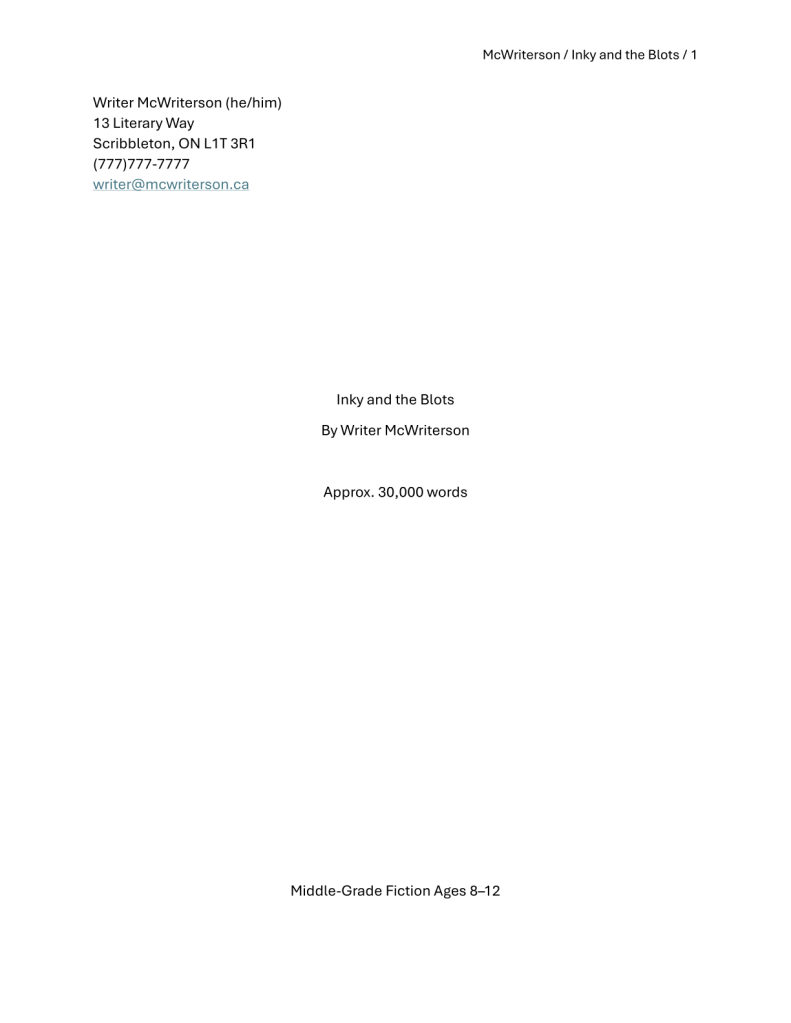
- Include a cover sheet with your title, genre/audience, word count, name, and contact information. The exact placement of most of these items can vary, but do centre the title partway down the page. You’ll see examples below.
- Using your program’s page-number function, add a header at the top right with your last name, your manuscript’s title (or a shortened version of it), and the page number.
- Present your text simply, justified to the left, in paragraph form.
- Use a basic, easily readable font, in black, and set the size to 12 pt.
- Use 1-inch (2.5 cm) margins (this should be your word processor’s default).
- Use double line spacing throughout.
- For line spacing, indentation, page numbering, and other consistent style features, use your word processor’s built-in tools rather than manually hitting keys each time. This will avoid a whole host of potential accidents.
- Use just one space after periods.
- Send your file as a .doc or .docx unless you’re told otherwise.
- If no specific instructions are given about how to name your file, it’s a good practice to make sure it includes both your name and your manuscript title.
Read the Submission Guidelines
Every agent and publishing house has submission guidelines. Some of them have very little to say about the formatting of your manuscript, but some are quite specific. When that’s the case, it’s usually because they’ve streamlined their workflow in a particular way and a manuscript that doesn’t abide by their guidelines will throw that workflow off. In the hectic world of publishing, that’s a valid reason to reject a manuscript. Read the guidelines! Follow the guidelines!
Jump Ahead:
Why Don’t Publishers and Agents Want a Designed Page Layout?
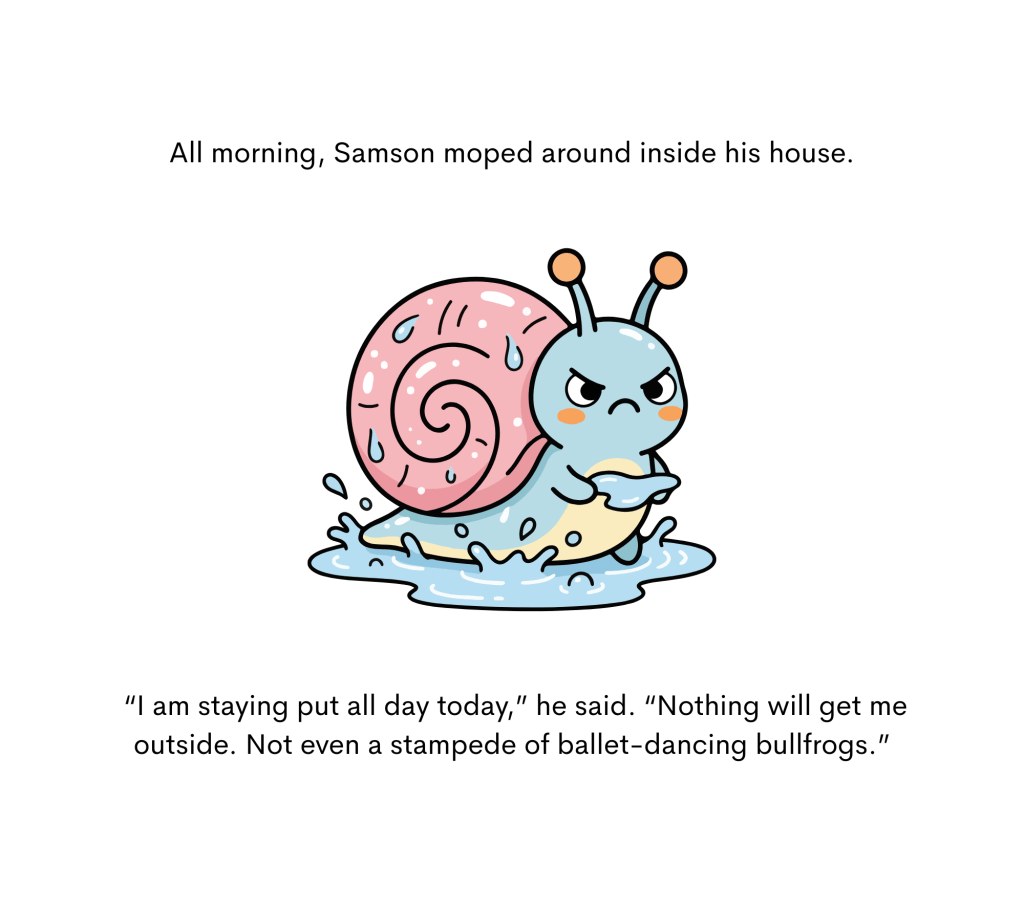
When editors receive a manuscript, they need to be able to work with it in its rawest form. They—and they sales and marketing teams they’ll be sharing your work with—know exactly what kind of books work best for their market, and they’ll immediately start imagining how yours can fit into the best possible niche. This is specialized knowledge they only gain from years of working at the company and being immersed in the market, and they will apply that knowledge to the editorial and design process for your book. The changes the editor suggests; the typeface the typesetter chooses; the cover design that makes it through all the rounds of internal feedback…these will all be influenced by what these professionals know about the tastes of those who will be most likely to buy your book.
When an aspiring author over-designs their submission, it sends a signal that they don’t understand the business relationship they’re trying to enter. At best, they haven’t learned very much about publishing yet. At worst, they think they know better than the teams of experts at the publishing house.
Also, more simply, adding formatting to your manuscript creates work. It has to be a bare-bones, formatting-free document before it can be properly edited, finalized, and imported into the professional design software where the actual layout will be completed. That program won’t recognize any of your word processor’s formatting, so it needs to be stripped out and replaced with cues the designer will follow.
Don’t worry. If you have specific ideas about how your book should look, you’ll have lots of time to discuss that with your editor…but first you need to send in a submission that meets their expectations and makes their life as easy as possible! Here are some samples to help you out.
Manuscript Format Examples
Novel Manuscript Format
Novels are the most basic kind of manuscript to format, but there are a few special rules:
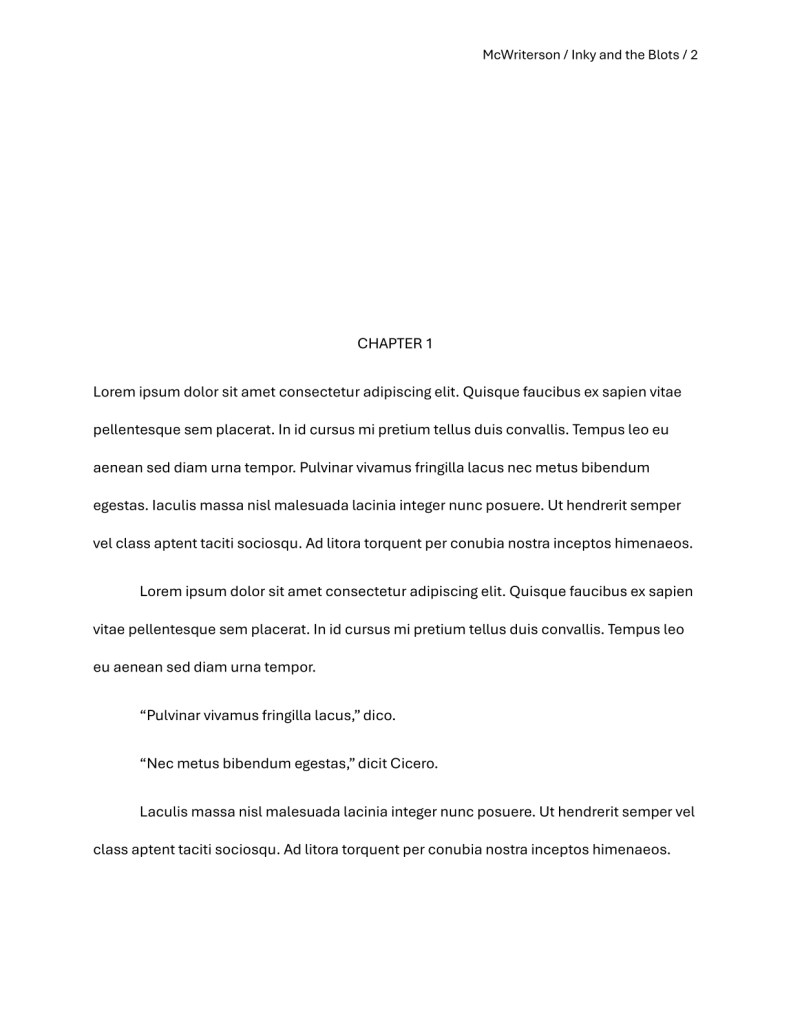
- Use your word processor’s page-break function to start every new chapter on a fresh page. Then hit enter several times and use centre alignment for your chapter number and/or title.
- Start your text on the next (double-spaced) line.
- Don’t add extra spacing between your paragraphs.
- Indent the first line of every paragraph except the first paragraph after a chapter break or editorial break.
Novel Manuscript Sample
Picture Book Manuscript Format
Picture book manuscripts are a little unique. They need to remain simple and text-based while communicating information about a highly visual final product. Here’s how to pull that off.
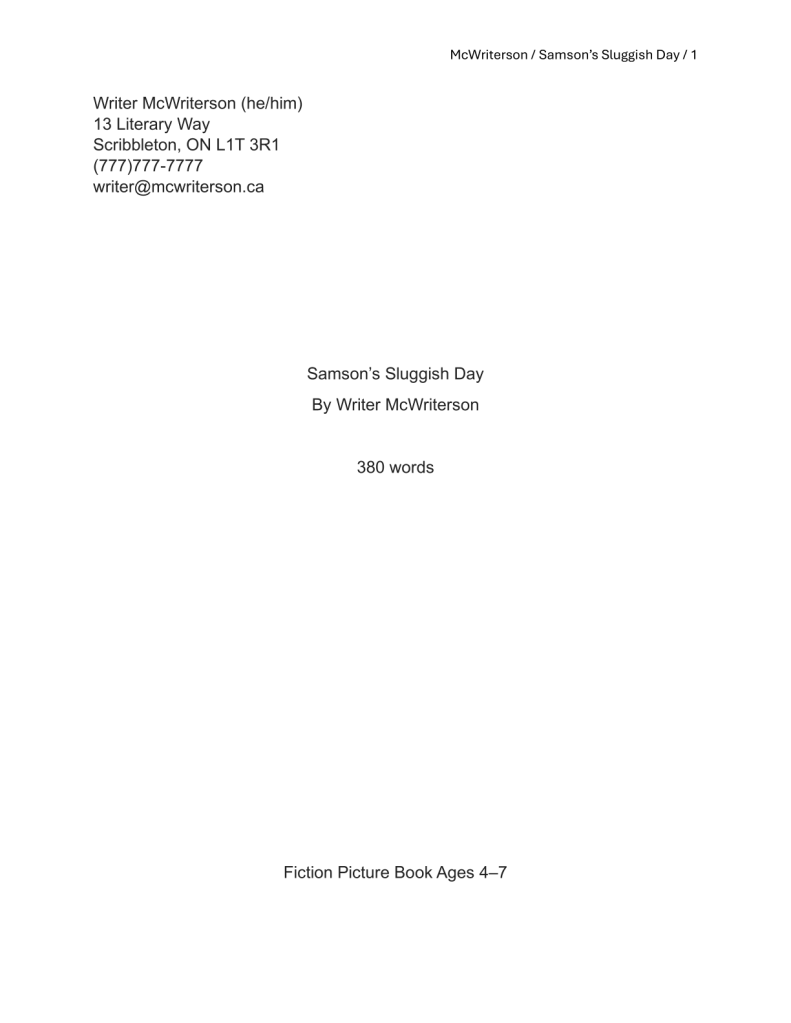
- If you’re an author-illustrator and would like to illustrate your own picture book, include some sample illustrations as a separate attachment. Your manuscript should still be all text. Note: if you’re not an author-illustrator, do not include any illustrations. In traditional publishing, choosing the illustrator is the publisher’s purview.
- If there are places where you need the illustration or text design to carry essential information that isn’t conveyed by the text (for example, if the narrator lies while the illustration shows the truth), use square brackets to add a brief art note. Keep it as bare-bones as possible.
- Don’t use manual page breaks. You can simply send your whole text as a single unbroken piece; however, if you know where your page breaks need to go, then type the page numbers in between your blocks of text. This makes it much faster to read and edit your manuscript.
- Picture books often use rhyme, free verse, standalone lines, and other text forms that are not standard paragraphs. If that’s the case for yours, feel free to use text size, line spacing, and indents creatively if you need to.
- If you’re an author-illustrator or if you’re proposing a concept that depends heavily on layout for meaning, you may include a dummy book in your submission in addition to the manuscript. A dummy book is essentially a mock-up of the complete picture book. For most authors, though, it’s best to send the manuscript alone.
Picture Book Manuscript Sample
![A plain, white manuscript page. Top right: McWriterson / Samson's Sluggish Day / 2. Beginning at top left: [Pages 4–5]
On Monday, Samson woke up feeling sluggish.
[Art note: Samson is a snail.]
[Pages 6–7]
All morning, Samson moped around inside his house.
“I am staying put all day today,” he said. “Nothing will get me outside. Not even a stampede of ballet-dancing bullfrogs.”
Just then, there was a strange rumble outside.
[Pages 8–9]
[Art note: it’s a stampede of ballet-dancing bullfrogs.]
THUMP! THUMP! SPROING!
THUNDER THUNDER THUNDER WHOMP!
PITTER PATTER CREAK CROAK!
[Pages 10–11]
“That was very strange,” said Samson. “But I am not going to look.”](https://erin-alladin.com/wp-content/uploads/2026/08/mcwriterson_picturebook_2025-07-25-2.png?w=791)
Poetry Manuscript Format
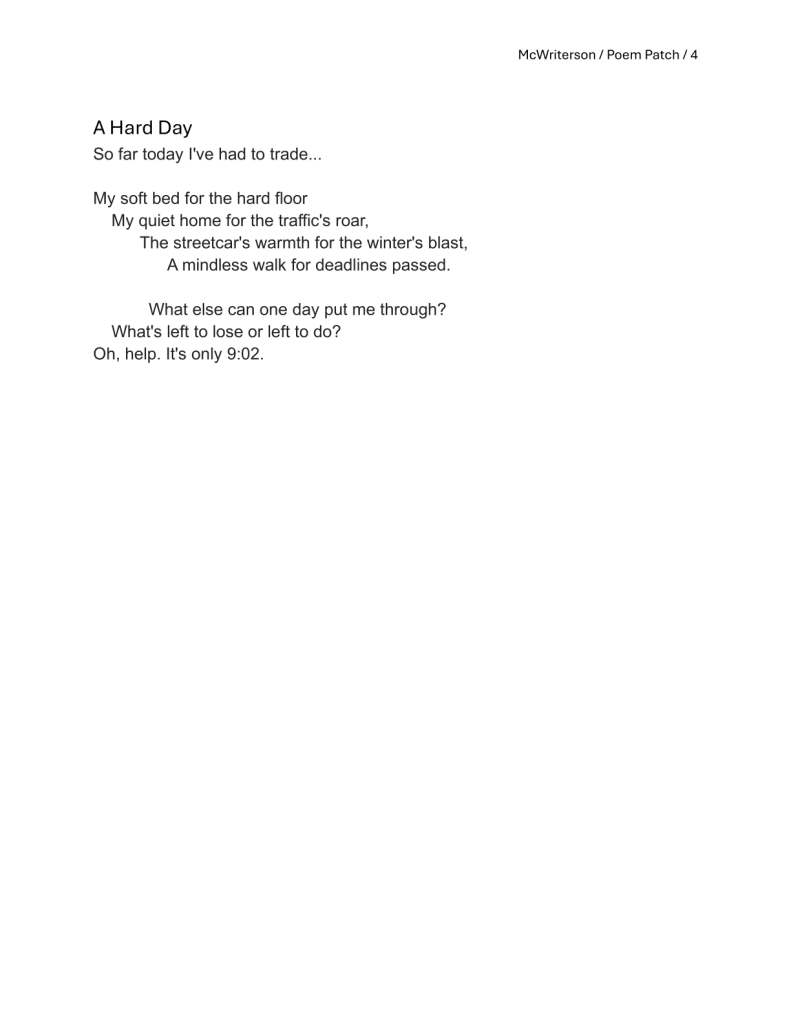
Poetry manuscripts have some additional rules, and some rules that supersede those in the general list:
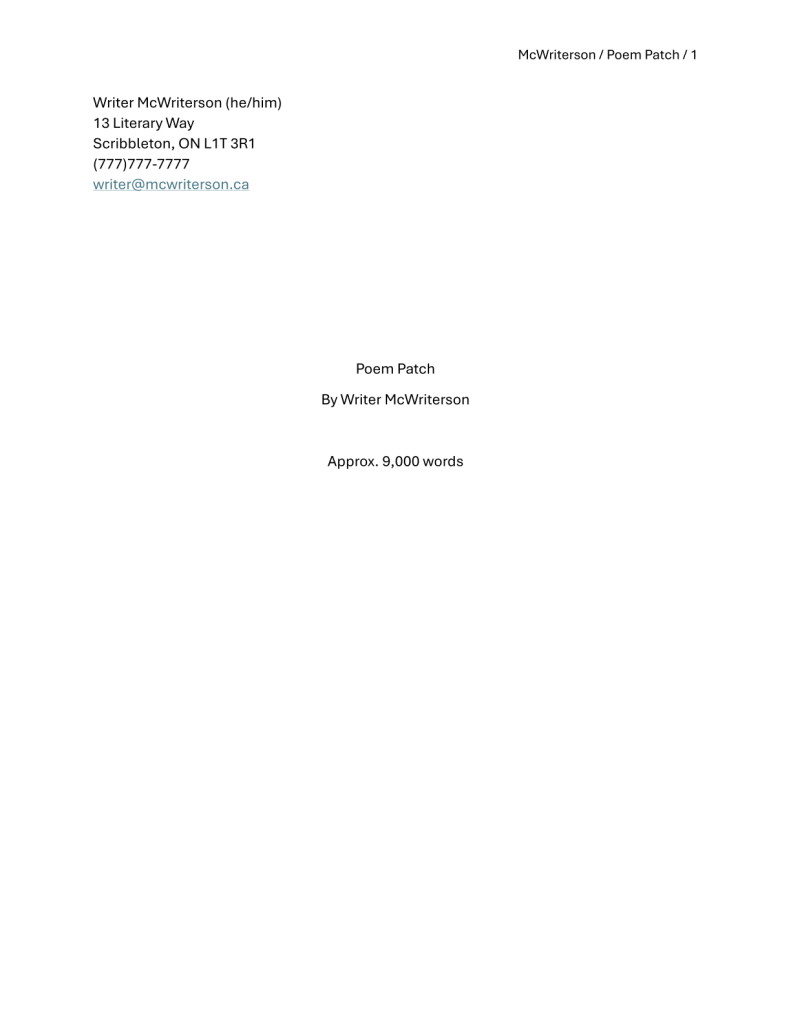
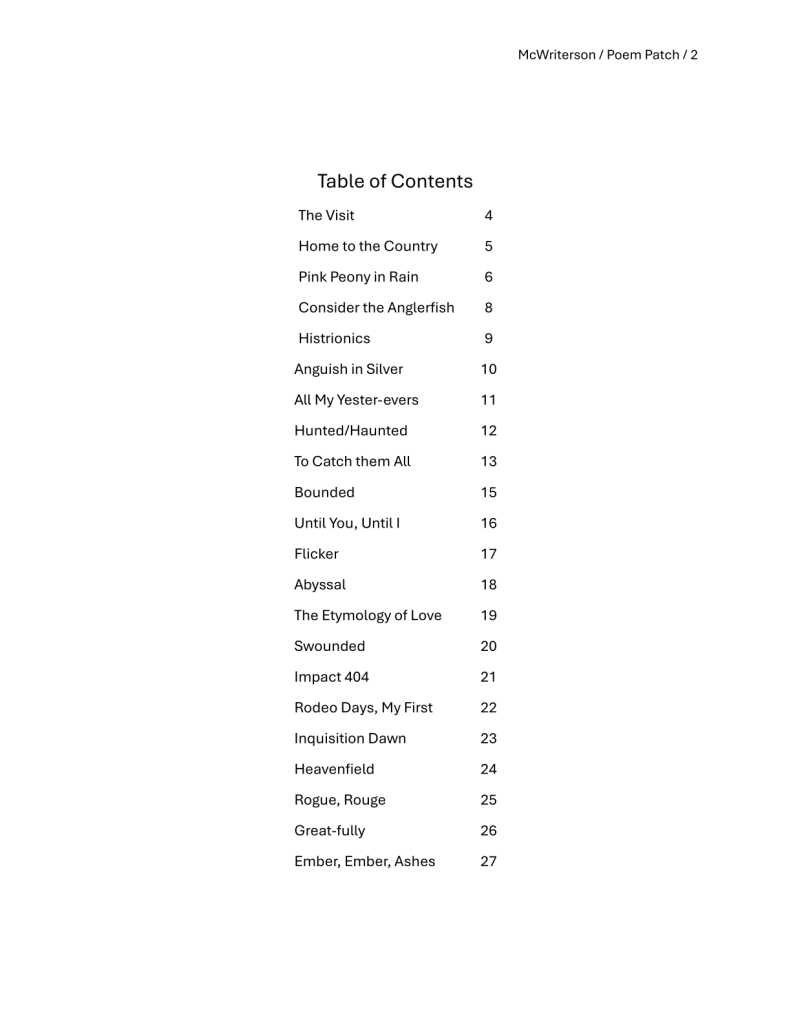
- You may include a table of contents after your cover sheet.
- If any of the poems you’re including have already been published, add an Acknowledgments page that notes these previous publications. You can also mention awards and grants related to these poems.
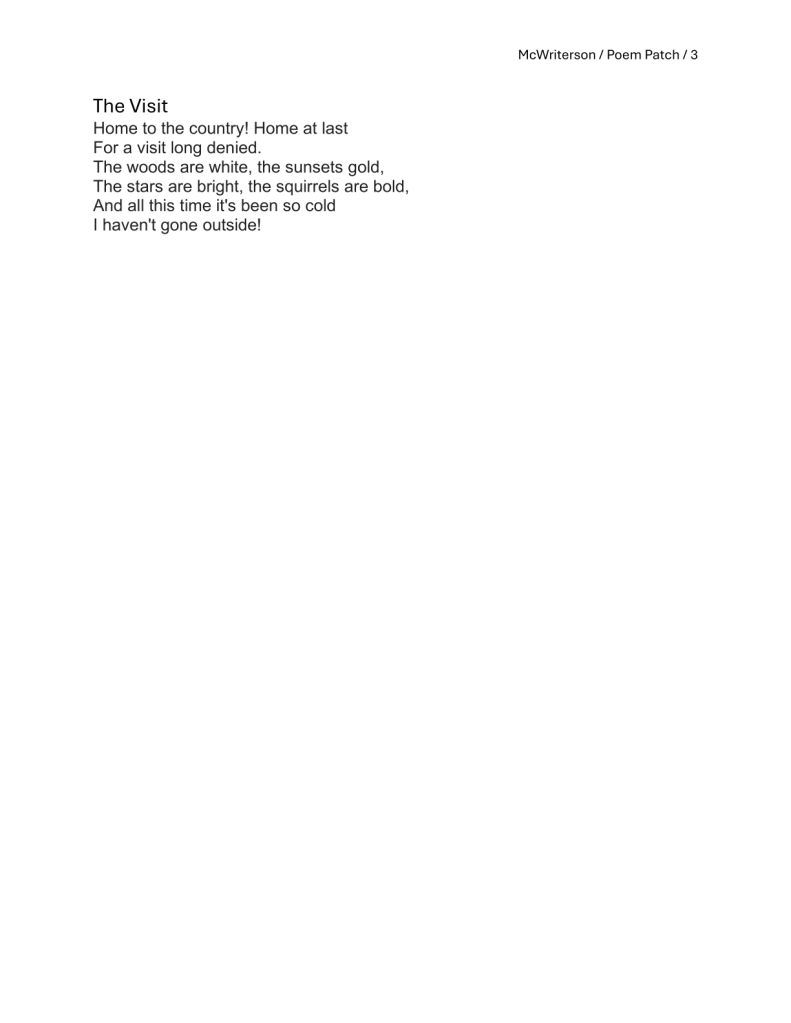
- Use the page-break function to start every poem on a new page.
- Choose a consistent formatting option to distinguish each poem’s title from the poem itself.
- Space your lines as you want them to appear in the published book.
- Poems sometimes demand creative placement of the text on the page. That’s understood. However, aim for as much consistency as possible without hampering your artistic expression. If a poem doesn’t need to be centred or shaped a particular way, do align it flush left.
- If you’re worried that important formatting might shift when your file is opened in another person’s word processor, include a PDF as well as the text file. They can edit the text file but view the PDF to confirm your formatting intentions.
Poetry Manuscript Sample
Nonfiction Manuscript Format
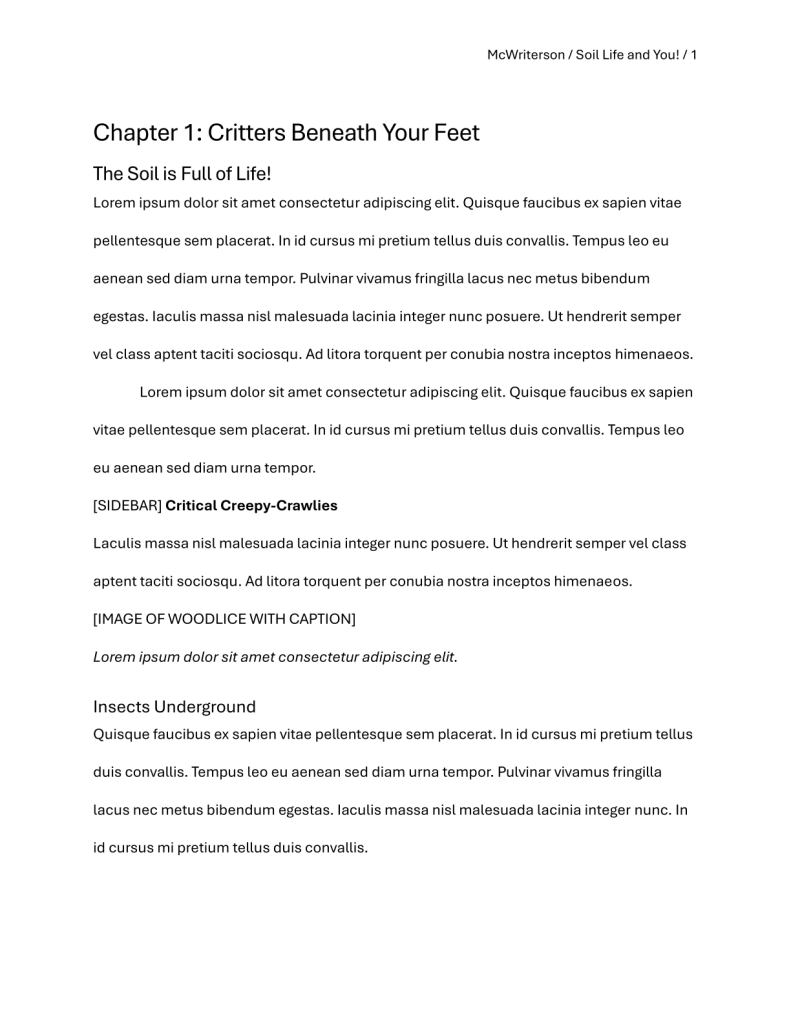
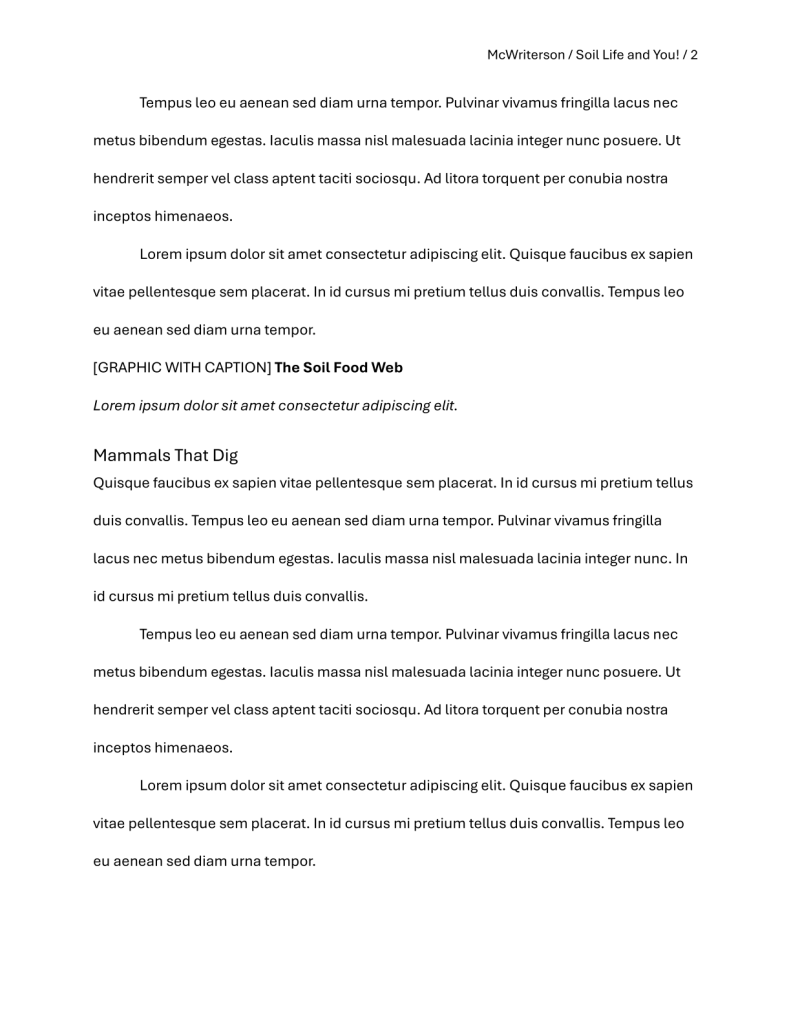
If you have an idea for a nonfiction book, you don’t need to start by submitting a manuscript. Instead, you’ll submit a book proposal. Once your book idea is accepted, your editor will give you specific guidelines for formatting your complete manuscript. However, before that happens, you do need to include some sample chapters in your book proposal package. Their job is to sell the editor on your book idea and demonstrate how the final book will be organized, so clarity and ease of navigation are important.
- If your nonfiction book uses a narrative format (this applies especially to memoir), refer to the rules for novels instead.
- Headings Option 1: Unless you’re told otherwise, you may use your word processor’s heading styles to organize the sections within your sample chapters. Be consistent: if you use Heading 1 for your chapter title, you should use Heading 2 for all your main sections, Heading 3 for subsections within each of them, etc. You’ll likely take these styles out later when you submit the whole manuscript according to the publisher’s instructions, but for now it makes for a nicely readable submission.
- Headings Option 2: If you’re advised not to use heading styles, use square brackets to indicate main headings, subheadings, etc.: [SUBHEADING] The Soil Is Full of Life!
- Use square brackets to indicate sidebars: [SIDEBAR] Critical Creepy-Crawlies
- Use square brackets to indicate where essential images should go. You may include the image’s caption: [IMAGE OF WOODLICE WITH CAPTION]
- Your publisher may invite significant input from you on your book’s layout, especially if you’re providing the visuals. However, they may not. Be prepared to discuss this in your initial meeting so you both know where you stand.
Get extra insights in your inbox.
Newsletter subscribers receive two extra doses of writing tips and publishing-industry knowledge every month. You’ll also get access to my full library of free downloadable writing guides.
You Might Also Like:
What a Literary Agent Wants Authors to Know
 Erin Alladin
Leave a comment